Posted by Editorial Team on Nov 24th 2026
The Complete Guide to Custom Soft Plastic Lure Design
Last Updated: October 28, 2026
Quick Summary
Custom soft plastic lure design means building a bait's profile, action, and finish around a specific fish and piece of water rather than buying what the tackle shop stocks. Start by matching forage, water clarity, cover, and season, then carry that shape through mold design, dimensions, and on-water testing.
- Match bait shape to the dominant forage, water clarity, cover, and season before opening a mold catalog.
- Every cavity wall needs a slight draft angle, commonly a degree or two per side, so baits release without tearing.
- For a 4- to 6-inch bait, body thickness typically runs 3/8 to 1/2 inch.
- Tail length usually runs 25-35% of body length on a 4- to 6-inch bait.
- Pour the same bait at different tail and body thicknesses and fish them side by side in clear water.
Table of Contents
- Start With the Fish: Designing a Custom Soft Plastic Lure
- Soft Plastic Lure Mold Design: From Sketch to Aluminum
- Custom Soft Plastic Swimbait Design and Hydrodynamic Action
- Soft Plastic Lure Dimensions That Actually Swim Right
- Using a 3D Printed Fishing Lure Mold in Your Workflow
- Plastisol, Color, Glitter, and Scent: Building the Bait
- Troubleshooting Defects and Testing Your Baits on the Water
- Choosing Your First Mold and Starter Kit
- Frequently Asked Questions
Start With the Fish: Designing a Custom Soft Plastic Lure
Custom soft plastic lure design means building a bait's profile, action, and finish around a specific fish and piece of water, not buying whatever the tackle shop stocks. Fat Guys Fishing offers aluminum molds from under 1 inch to over 10 inches.
Matching Bait Shape to Species and Water
Bait shape should follow the forage the fish actually eat. A pressured bass lake with a shad population calls for a slim, baitfish-style profile. A river smallmouth holding behind rock calls for something compact and craw-shaped that stays in the strike zone longer.
Work through this order before you ever open a mold catalog:
- Forage: Match the dominant baitfish, craw, or amphibian in the water.
- Water clarity: Clear water rewards realistic detail and natural color; stained water rewards silhouette and vibration.
- Cover: Heavy grass and wood call for a bait that slides through without snagging.
- Season: Cold water usually means a smaller, slower profile; warm water supports bigger, more aggressive baits.
Get that list right and the rest gets easier; get it wrong and no pouring skill saves the bait.
Soft Plastic Lure Mold Design: From Sketch to Aluminum
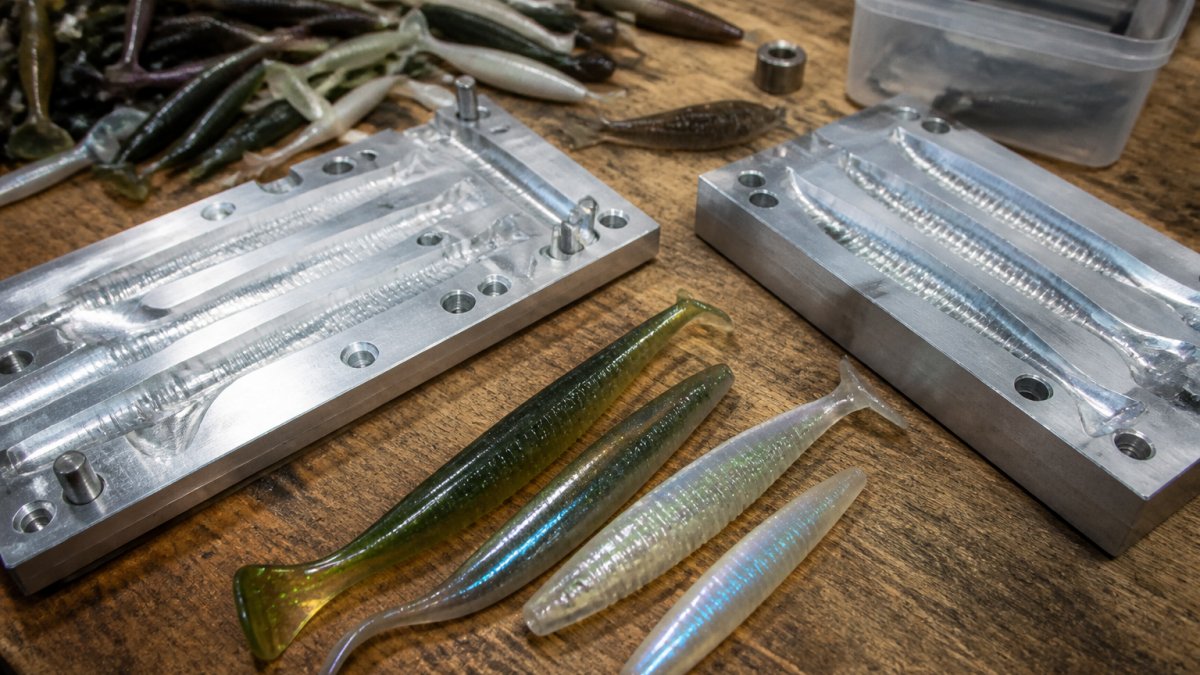
A mold holds the cavity that shapes the plastic. Fat Guys Fishing offers aluminum molds for making custom soft plastic baits.
Here's the workflow we recommend:
- Sketch the profile at full size, side and top view, with the hook slot marked and the intended rigging noted.
- Model the cavity in CAD if you're going custom, or match your sketch to an existing mold cavity.
- Engineer the mold block, draft, parting line, venting, sprue, and clamp strategy, before any metal is cut.
- Cut the mold in aluminum, with venting and a sprue sized to the bait.
- Test pour a small batch before committing to a full production run.
The Engineering Details That Decide Mold Quality
Most mold problems are designed in, not poured in. Check these before committing a design to aluminum:
- Draft angle: Every cavity wall needs a slight taper, commonly a degree or two per side, so the cured bait releases without tearing. Zero-draft walls grip the plastic; steep draft releases easily but rounds off fine features like rib edges and tail segments.
- Parting line: The parting line is where the two mold halves meet. Put it on a natural edge of the bait, along the back, the belly, or a lateral line, so any flash is easy to trim and lands where it won't affect action. A parting line run across a paddle tail's face will show in the swim.
- Venting: Air must escape as plastic fills the cavity. Thin vent channels at the cavity's high points let air out without letting plastic run. Poor venting is the most common cause of incomplete fills and rounded detail, check it first when a good mold starts short-shooting.
- Sprue and gate sizing: The sprue is the channel the plastic travels through. Too small and plastic cools before reaching the far end of the cavity; too large and you waste material and create a big trim tab. Size it to the bait's volume and your pour temperature.
- Clamping and alignment: Dowel pins or interlocking features keep the halves registered. A mold that shifts between halves produces offset baits and thin walls on one side.
Hand-Pour Molds vs. Injection Molds
| Consideration | Hand-pour mold | Injection mold |
|---|---|---|
| Equipment | Open cavity, gravity fill | Press or injector, closed cavity |
| Detail capture | Good with proper venting | Excellent on fine features |
| Production speed | Slow, one or few cavities at a time | Fast, multi-cavity |
| Setup cost | Lower | Higher |
| Best for | Prototypes, short runs, custom shapes | Repeatable volume, tight tolerances |
Why Mold Detail Decides Bait Performance
This is where silicone molds lose ground: they flex under heat, so fine detail softens over repeated pours, and they crack along the seam. Aluminum holds its shape, so the hundredth bait looks like the first. If a mold gave up after a dozen pours, the material was the problem, not your technique.
Custom Soft Plastic Swimbait Design and Hydrodynamic Action
Custom soft plastic swimbait design is one aspect of lure making.
Soft Plastic Lure Dimensions That Actually Swim Right
Soft plastic lure dimensions decide whether a bait runs true or blows out. Length gets the attention, but thickness and tail proportions matter more. A soft plastic bait is a hydrodynamic object first and a fish-catching object second, every dimension changes how it moves water, and that movement is what a fish feels through its lateral line before it ever sees the bait.
How Dimensions Drive Sink Rate, Vibration, and Swim Action
A useful starting frame for a bait in the 4- to 6-inch range:
| Dimension | Typical Range | What It Controls |
|---|---|---|
| Overall length | 4-6 inches | Forage match and hook size |
| Body thickness | 3/8-1/2 inch | Fall rate, displacement, and hookset strength |
| Tail length | 25-35% of body | Kick speed and water displacement |
| Tail thickness | 1/8-3/16 inch | Durability vs. action trade-off |
| Hook slot depth | Sized to hook gap | Rigging security and tear resistance |
Scale those proportions up or down for larger and smaller baits rather than copying them literally. A 10-inch bait built to the same ratios as a 4-inch bait will swim, but it will swim slowly, which is usually what you want for big fish anyway.
Reading Action in Clear Water
The fastest way to learn how dimensions interact is to pour the same bait at two or three tail thicknesses and two body thicknesses, then fish them side by side in clear, shallow water. Watch three things: how fast the tail kicks on a slow retrieve, whether the bait tracks straight or rolls, and how it falls on a slack line. A bait that rolls at slow speed has too much tail area for its body; one that won't kick until burned back has too little tail area or too firm a plastic. Adjust one variable at a time and re-pour, this loop separates a designed bait from a copied one.
Using a 3D Printed Fishing Lure Mold in Your Workflow
So print to test, machine to produce. Once a shape proves itself on the water, move it to aluminum and stop worrying about the mold.
Plastisol, Color, Glitter, and Scent: Building the Bait
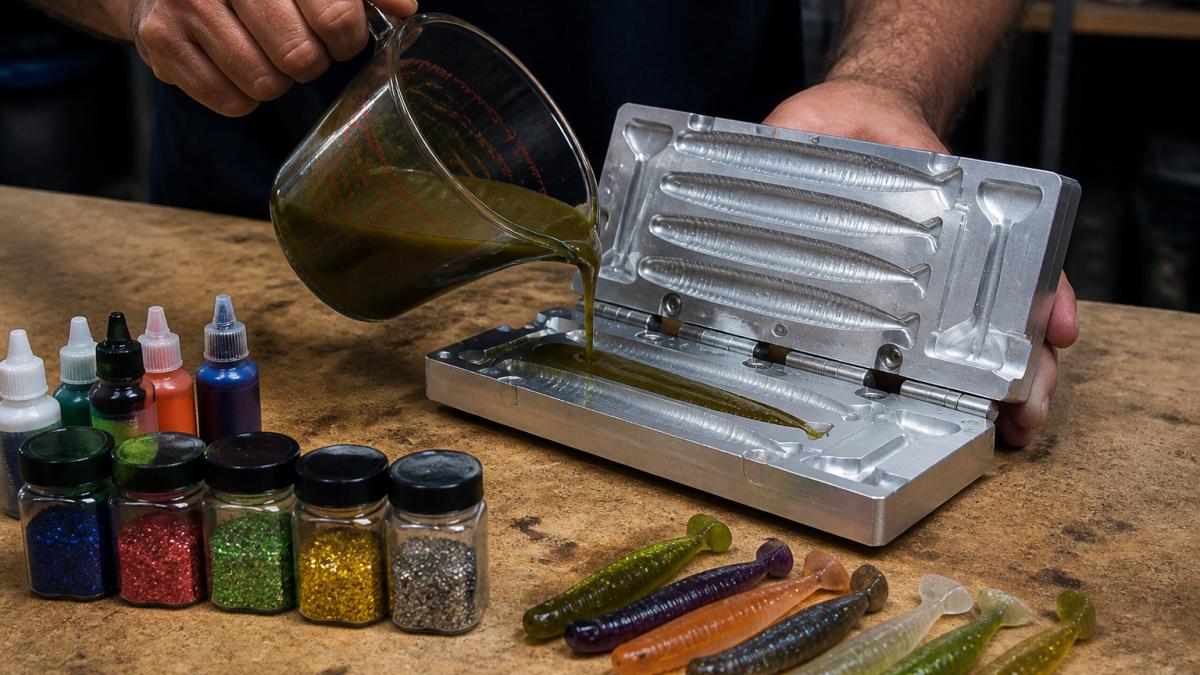
Stir the plastisol slowly and consistently. Bubbles come from agitation, and bubbles become weak spots in the finished bait.
Troubleshooting Defects and Testing Your Baits on the Water
Testing is the step makers skip. Fish a handful of baits side by side with a store-bought bait of similar size and watch fall rate, tail kick, and how the bait sits on the hook. If yours doesn't out-fish the commercial one, the design isn't finished.
Choosing Your First Mold and Starter Kit
Fat Guys Fishing offers starter kits for custom bait making. From there, add molds as you identify gaps, not because a catalog looks interesting.
Fat Guys Fishing offers aluminum molds from under 1 inch to over 10 inches, including Slayer Systems and Slide Systems. Starter kits are available, along with bargains and blemished items.
Frequently Asked Questions
How do you design a custom soft plastic fishing lure from scratch?
Fat Guys Fishing offers aluminum molds for making custom soft plastic fishing baits, with sizes from under 1 inch to over 10 inches.
What makes a soft plastic lure have more action?
Fat Guys Fishing offers aluminum molds for making custom soft plastic fishing baits, including Slayer Systems and Slide Systems.
Can you make a custom soft plastic lure mold at home?
Fat Guys Fishing offers aluminum molds for making custom soft plastic fishing baits, with sizes from under 1 inch to over 10 inches.
What size should a custom soft plastic fishing lure be?
Fat Guys Fishing offers aluminum molds in sizes from under 1 inch to over 10 inches.
How can you customize the color of a soft plastic lure?
Fat Guys Fishing offers aluminum molds for making custom soft plastic fishing baits.
How do you avoid air bubbles and incomplete fills when pouring baits?
Fat Guys Fishing offers aluminum molds for making custom soft plastic fishing baits.
The gap between a bait that looks right and a bait that fishes right comes down to mold quality and a willingness to test. We build aluminum molds that hold their detail through repeated pours, so the tenth bait matches the first, and we back that with starter kits for beginners and precision systems for tournament anglers. Get started with Fat Guys Fishing and pour a bait built around your water, not someone else's.
